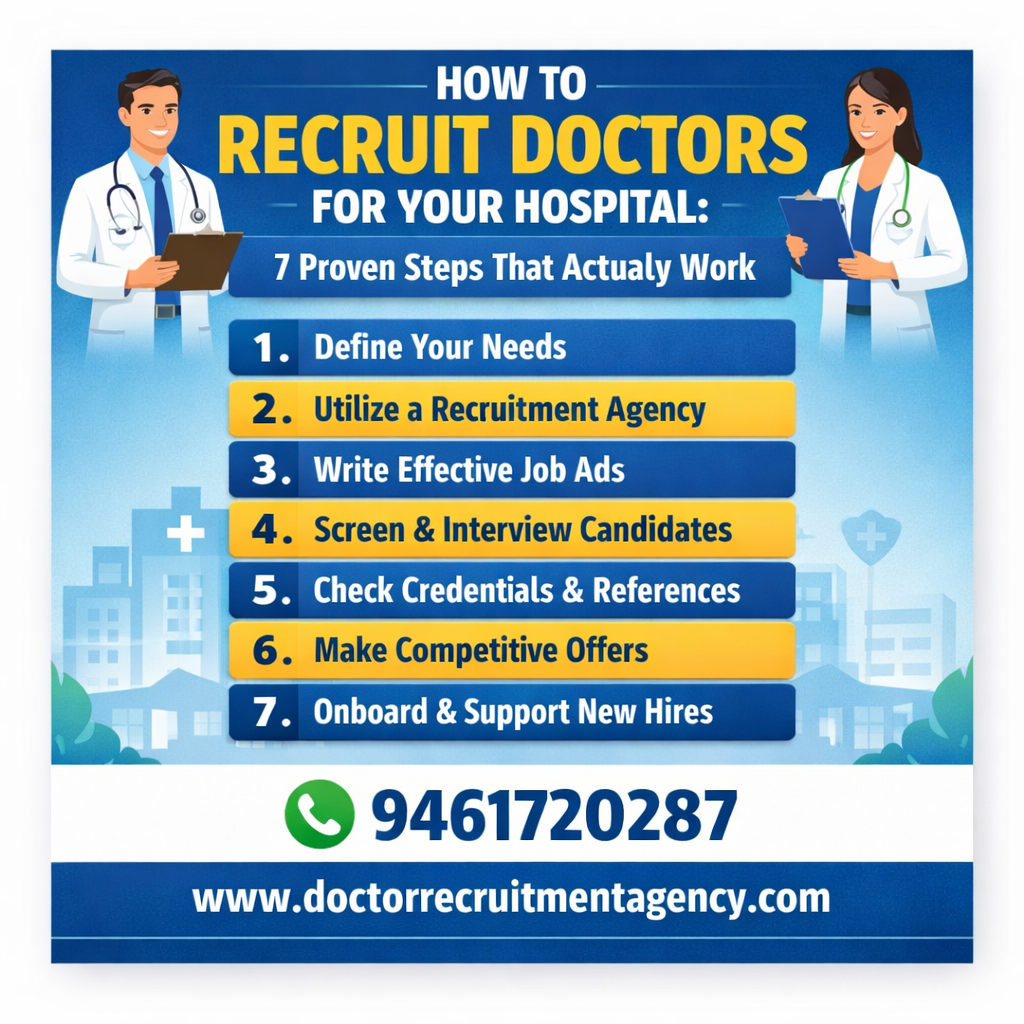
Recruiting the right doctors for your hospital is one of the most critical — and most challenging — tasks any healthcare administrator faces. With a growing global doctor shortage, increasing patient demand, and fierce competition among hospitals and clinics, knowing how to recruit doctors for your hospital effectively can make or break your institution's performance.
Whether you are hiring your first consultant, scaling a multi-speciality team, or filling an urgent vacancy, this guide walks you through a proven, step-by-step process to attract, assess, and onboard top medical talent — fast.
Let's dive in.
Step 1: Define the Role Clearly Before You Start Hiring
The biggest mistake hospitals make is rushing to post a job without a clear, detailed role definition. A vague job description attracts the wrong candidates — wasting your time and theirs.
Before you recruit, define the following clearly:
- Speciality required (e.g. General Practitioner, Surgeon, Psychiatrist, Radiologist)
- Permanent, locum, or contract position
- Full-time or part-time hours
- Clinical responsibilities and patient load
- Required qualifications, registrations, and experience level
- Salary range and benefits package
- Start date and contract duration
Pro tip: Involve your existing clinical leads in writing the job description. They know exactly what the team needs — and their input results in better hires.
Step 2: Choose the Right Doctor Recruitment Channels
Not all recruitment channels deliver equal results when hiring doctors. The medical profession has its own networks, portals, and communities. Using the right platforms ensures you reach qualified, registered physicians — not just anyone searching for jobs.
Top channels for doctor recruitment
Step 4: Screen and Shortlist Candidates Efficiently
Once applications arrive, a structured screening process saves you hours and protects your hospital from compliance risk. Rushing this stage is where most hiring mistakes happen.
Your screening checklist should cover:
- Valid medical registration with the GMC (UK), MCI (India), or relevant national body
- Specialist qualifications (MRCP, FRCS, etc.) relevant to the role
- Right to work or visa status verification
- Gap analysis of CV — unexplained gaps should be explored at interview
- Indemnity cover and professional insurance
- Enhanced DBS / police clearance (for patient-facing roles)
- References from at least two recent clinical supervisors
Using a doctor recruitment agency at this stage is especially valuable — they carry out these compliance checks on your behalf, reducing your administrative burden and legal risk considerably.
Step 5: Conduct a Structured Clinical Interview
Interviewing doctors requires a different approach than most professional hiring. You are assessing clinical competency, patient-safety mindset, communication skills, and cultural fit with your team — all at once.
Recommended interview structure:
- Stage 1 — Video or phone screen (20–30 min): Confirm motivation, availability, salary expectations, and basic communication skills.
- Stage 2 — Clinical competency interview (45–60 min): Use competency-based and scenario questions. Include a clinical lead or department head on the panel.
- Stage 3 — Practical assessment (where relevant): For surgical or procedural specialties, a technical skills test or case presentation may be appropriate.
- Stage 4 — Values and culture fit conversation: A more informal discussion with the wider team to assess fit with your hospital's culture and values.
Always use a scoring rubric and have at least two interviewers. This reduces unconscious bias and creates a fairer, more consistent process.
Step 6: Make a Competitive Offer and Move Quickly
Many hospitals ask whether to recruit directly or use a specialist doctor recruitment agency. Here is a simple side-by-side comparison to help you decide:
| Factor | Direct Hiring | Using a Recruitment Agency |
|---|---|---|
| Time to hire | 4–12 weeks | 1–3 weeks (pre-vetted candidates) |
| Candidate pool | Limited to active job seekers | Active + passive + international |
| Compliance checks | Your responsibility | Handled by the agency |
| Cost | Lower upfront | Agency fee, but faster ROI |
| Specialist roles | Difficult | Agency specialisation helps greatly |
| Overseas recruitment | Complex | Agency manages visas & GMC registration |
Frequently Asked Questions
How long does it take to recruit a doctor for a hospital?
It depends on the speciality and recruitment method. Direct hiring typically takes 4–12 weeks. Using a specialist doctor recruitment agency can reduce this to 1–3 weeks, as they maintain a pre-vetted pool of available candidates.
What qualifications should I look for when recruiting a doctor?
At minimum, a valid registration with the appropriate medical council (e.g. GMC in the UK, NMC, or state medical council in India), the required specialist qualifications for the role, a clean professional record, and recent relevant clinical experience.
How much does it cost to recruit a doctor through an agency?
Agency fees typically range from 10% to 20% of the doctor's first-year salary, depending on the role's seniority and speciality. While this feels significant, it often saves far more in administrative time, compliance costs, and the cost of a vacant post.
Can I recruit doctors from overseas for my hospital?
Yes. International doctor recruitment is a practical solution for hard-to-fill specialties. A specialist recruitment agency will manage the process including GMC/IMC registration, visa sponsorship, and relocation support.
What is the biggest mistake hospitals make when recruiting doctors?
- Specialist medical job boards: Sites like NHS Jobs, Doctors.net.uk, BMJ Careers, and DocDoc attract qualified, registered physicians actively seeking roles.
- Doctor recruitment agencies: A specialist agency gives you immediate access to a pre-vetted pool of candidates, handles compliance checks, and dramatically reduces your time-to-hire. This is particularly valuable for urgent or senior positions.
- LinkedIn and professional networks: Many consultants and specialists are passive candidates — not actively job-seeking but open to the right opportunity. A well-crafted LinkedIn outreach campaign reaches this hidden talent pool.
- Medical associations and colleges: Royal Colleges, BMA networks, and specialty associations often have job boards or newsletters. Advertising here reaches highly credentialed doctors.
- Employee referrals: Your existing clinical staff are your best recruiters. A structured referral programme with incentives can surface high-quality candidates quickly.
- International recruitment: For hard-to-fill specialties, recruiting from overseas — with the support of a specialist agency handling GMC registration, visa sponsorship, and relocation — can fill critical gaps.
Step 3: Write a Compelling Job Advertisement
A job advert for a doctor is not just a list of requirements — it is a marketing document. The best candidates have options. Your advert must answer the question every physician asks when reading a job post: "Top 10 Healthcare Recruitment Agencies in India for Hospitals"
A high-performing doctor job advert includes:
- A clear, specific job title (e.g. 'Consultant Cardiologist — NHS Trust, London' not just 'Doctor Needed')
- A compelling opening paragraph about your hospital's mission, values, and the team they will join
- A concise list of clinical responsibilities (not an exhaustive policy document)
- Minimum and preferred qualifications — be realistic, not wish-list-driven
- Salary range, benefits, and any relocation or visa support offered
- Information about professional development, training, and career progression
- A warm, human closing paragraph with a clear call-to-action
Remember: Doctors receive many approaches. A generic, copy-paste advert gets ignored. A specific, authentic, well-written one gets applications.
In competitive specialties, the best doctors are often in conversation with multiple hospitals simultaneously. A slow offer process loses candidates — sometimes permanently.
Tips for a winning offer:
- Research market salary benchmarks before interviewing — know your offer range in advance
- Make the verbal offer within 24–48 hours of the final interview
- Follow up immediately with a formal written offer letter
- Be transparent about the full package: salary, pension, leave, CPD allowance, on-call commitments
- If a candidate is weighing up multiple offers, have a direct conversation about what matters to them
- Offer relocation support or accommodation assistance for candidates moving from another region or country
Step 7: Onboard Effectively to Retain Your New Doctor
Recruitment does not end at the offer letter. The way you onboard a new doctor in their first weeks directly impacts how long they stay. Poor onboarding is one of the leading causes of early resignation in healthcare.
A strong physician onboarding programme includes:
- A pre-arrival welcome pack with all contracts, policies, and information about the hospital
- A dedicated buddy or mentor from the clinical team for the first 90 days
- A structured induction covering IT systems, protocols, safeguarding, and patient pathways
- An early check-in meeting at 2 weeks and a formal review at 30 and 90 days
- Clear communication about career development opportunities within your institution
- Access to CPD (Continuing Professional Development) time and budget
- A genuine, open-door culture where concerns can be raised early
Fact: Doctors who go through a structured onboarding programme are significantly more likely to stay beyond their first year. The cost of re-recruiting is always higher than the cost of retaining.
Doctor Recruitment Agency vs. Direct Hiring: A Quick Comparison
Moving too slowly. The best candidates are often considering multiple opportunities simultaneously. Hospitals that delay interview scheduling or offer decisions regularly lose top candidates to faster-moving competitors.
Should I use a general recruitment agency or a specialist doctor recruitment agency?
Always use a specialist. A doctor recruitment agency understands medical registration requirements, clinical competencies, compliance standards, and the unique culture of healthcare organisations. A generalist recruiter will not.
Conclusion: Recruit Smarter, Not Just Harder
Knowing how to recruit doctors for your hospital is no longer just an HR skill — it is a strategic competency. The hospitals that attract and retain the best medical talent are the ones that treat recruitment as a professional, structured process — not an afterthought.
Whether you recruit directly or partner with a specialist doctor recruitment agency, the seven steps in this guide will significantly improve your results: better candidates, faster hires, stronger retention, and ultimately — better patient care.
Need Help Recruiting Doctors for Your Hospital?
Our specialist doctor recruitment agency has placed hundreds of physicians across hospitals, NHS Trusts, and private clinics. We handle everything — from sourcing and compliance checks to offer management and onboarding support.
Contact us today for a free consultation 9461720287 call now — and let us find your next great doctor.
Tags: doctor recruitment agency, how to recruit doctors for hospital, physician staffing, medical recruitment, locum doctor agency, healthcare talent acquisition